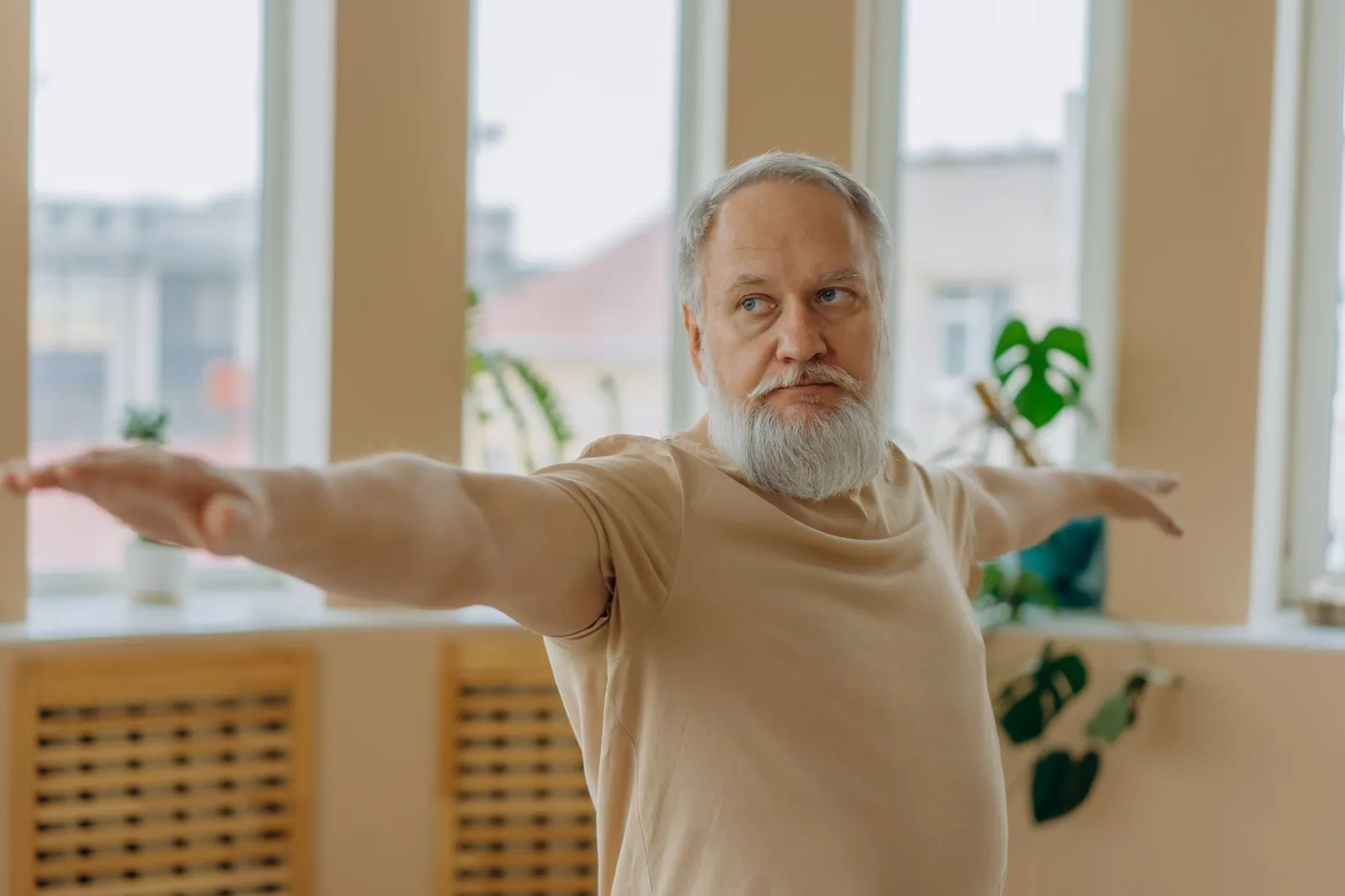
Walk into any drop-in yoga class on any given morning and count how many people settle into Warrior II without being asked. You will not need both hands.
There is something about this pose that makes students come back, teachers keep cueing it, and school after school claims it. It is not fashionable. It does not trend on social media. It is old, steady, and a little stubborn — and that is exactly why it works.
The hips do the work the shoulders want to take credit for. In Warrior II, the front knee wants to drift inward. The natural impulse is to yank the shoulder blades back and lift the chest, as if the pose lives in the upper body. It does not. The pose lives in the hips. When you root through the outer edge of your back foot and draw your front hip crease slightly forward, the shoulders naturally settle. The chest opens without forcing it. Students who learn this hip-first cue once tend to remember it, and that is part of why they return — the pose keeps teaching something real.
The breath anchors the intensity. Warrior II is a heating pose. The muscles work, the heart rate climbs, and a new student often interprets that as a signal to tense up and hold the breath. Teachers who cue a slow, deliberate exhale on the bend — not a snap or a sigh, but a deliberate, audible release — give students something to follow. The breath becomes a rhythm for staying present inside the posture instead of white-knuckling through it. That is the difference between a student who leaves class feeling wrung out and one who leaves feeling open.
The transition is the lesson. Most students experience Warrior II as a standalone pose, but in a flowing sequence it does something more interesting. Moving from Warrior II into Parsvakonasana or a forward fold, then circling back through Reverse Warrior, teaches the spine how to move in three planes while the legs stay active. Students who grasp this — even before they can articulate it — develop a body intelligence that keeps pulling them back to the mat. The pose is not the destination. The transition is the education.
It meets students where they are on any given day. Some mornings the knees track perfectly and the breath flows easily. Other mornings everything is stiff and the front hip is screaming. Warrior II adapts. A student can shorten the stance, micro-bend the knee, or lift the arms lower and still receive the pose's core benefits. That scalability makes it a reliable tool rather than an all-or-nothing test. Beginners feel the learning. Advanced students find refinement.
If you have been practicing for a while, you probably already know the feeling of walking into a class and finding yourself in Warrior II again — not because the teacher ran out of ideas, but because there is still something there to learn. Next time you settle in, try letting the hips lead, following the exhale, and noticing the transition out of it. You might find it feels different than it did last year.
Want more alignment insights and beginner-friendly yoga breakdowns? Join our mailing list and we will send you a free guide to the five poses that build a practice from the ground up.